Is oak timber suitable for exterior cladding?
Yes. Oak is durable, strong, and naturally resistant to decay and insect damage, making it ideal for long-lasting external cladding. Both our live edge and feather edge cladding boards are sourced from English woodlands, providing a sustainable and native product in which to clad your building. For internal cladding, we recommend using kiln-dried oak with a low moisture content.
Why choose English Solid Oak cladding?
Selecting English oak timber cladding can support planning applications because it is a native species, often preferred by local authorities for conservation areas, heritage sites, or listed buildings. While European oak is also widely used, English oak is more likely to meet planning guidelines due to its native origin, traditional authenticity, and sustainable local sourcing, which supports UK forestry and reduces environmental impact.
How long does fresh sawn green oak cladding last outdoors?
With correct installation, proper ventilation and regular maintenance, oak hardwood cladding can last 25–50 years or more.
Oak Cladding Maintenance:
-
Clean:
Remove dirt, moss and mildew 1–2 times per year with a soft brush or low-pressure wash.
-
Inspect:
Check for cracks, splits, moisture damage and signs of insects or fungi.
-
Repair:
Replace damaged boards and ensure screws or nails are secure and rust-free.
Does green oak cladding need treatment?
Green Oak cladding will naturally weather to a silver-grey patina. However, UV oils or stain treatments can be applied if you want to preserve the original colour and extend its lifespan. Always test any product on a hidden area or sample first.
Can oak cladding be installed over insulation?
Yes, this is often required for building control. A breathable membrane and battens create a ventilated cavity over the insulation, while the oak cladding itself provides weather resistance by acting as a durable outer layer that sheds rainwater, blocks wind, and protects the underlying structure, all while allowing the timber to breathe naturally.
What is a feather edge profile?
A feather edge profile is a type of timber board that is tapered in thickness, with one edge thinner than the other. This allows each board to overlap the next, creating a tight, weather-resistant joint that sheds water effectively. This profile can be used as an alternative to tongue and groove for horizontally cladding external walls.
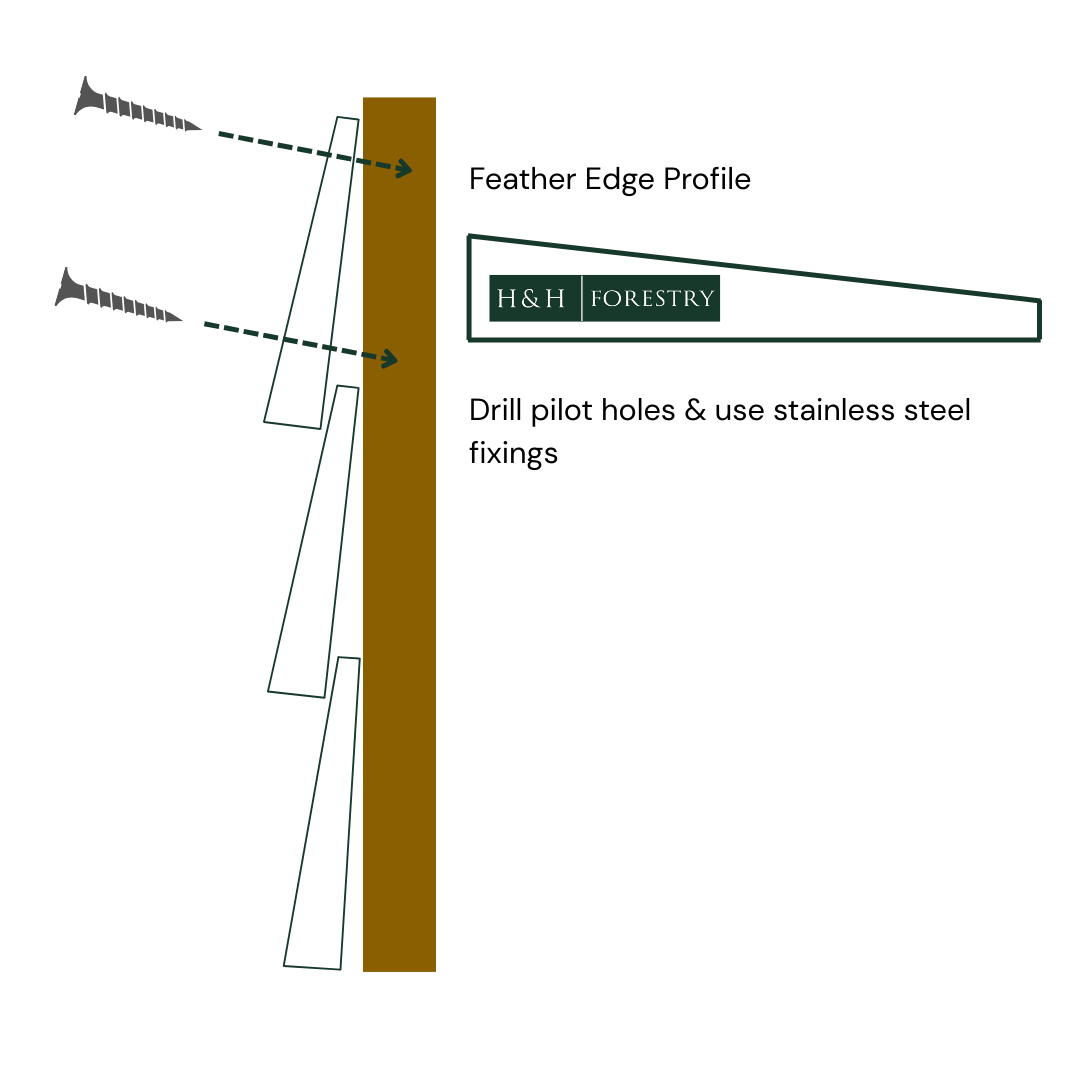
Common uses:
- External cladding for houses, cottages and barns
- Garden buildings such as sheds or summerhouses
- Fences, boundary walls and cladding panels
- Pergolas requiring wind and weather protection
How should external oak cladding be fixed?
Typically, it’s fixed to battens ensuring ventilation gaps and often installed over weatherproof membranes. Battens should ideally be spaced at 400–500 mm centres.
As oak will expand and contract with humidity and seasonal changes, it's important to leave expansion gaps (3–5 mm) between board lengths. To help compensate for shrinkage and expansion, you could create oval holes (or slots) for fixings to allow some lateral movement. Using two fixings per board width is recommended to help reduce cupping, especially on wide boards.
When creating adjoining elements such as corners, windows, or doors or between cladding sections, it is also recommended to leave a shadow gap, a small recessed space that allows the timber to expand and contract naturally while maintaining a clean, precise appearance and preventing distortion or warping at junctions.
We recommend using 4–5 mm stainless steel wood screws and drilling pilot holes to prevent splitting the oak cladding, particularly near board ends. Screws can be countersunk if they will remain visible.
What type of fixings should be used for oak cladding?
For external oak cladding, stainless steel fixings (A2 or A4 grade) are essential. Oak contains tannins that can react with iron-based metals, leading to black staining and corrosion. Stainless steel avoids this issue and offers durability.
Best Fixings:
Stainless steel screws are preferred for structural security, removability, and precision. We recommend using 4–5 mm diameter wood screws and drilling pilot holes to avoid oak boards splitting, especially near ends.
Alternatives:
Stainless steel annular ring nails may be used for a cleaner aesthetic or in traditional applications, especially in hidden fixing. Pneumatic nail guns are often used for speed; however, you must be careful not to split the oak cladding boards.
Avoid:
Galvanized, zinc-coated, or mild steel fixings as they will corrode and stain oak.